
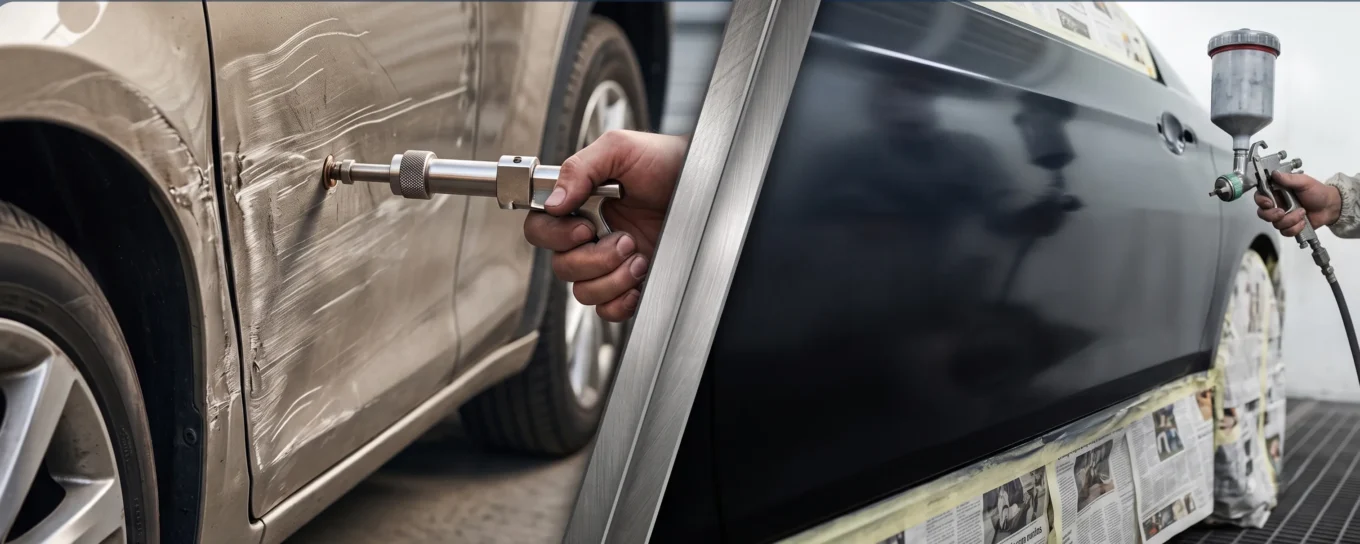
Dents and paint damage are two of the most common reasons car owners start searching for a body shop — and also two of the areas where it’s easiest to get a bad result if you pick the wrong one. A rushed dent repair or a mismatched paint job doesn’t just look bad, it can hurt your car’s resale value for years.
We work on dent removal and paint jobs at our studio almost every day, so this guide isn’t generic advice pulled from a checklist. It’s what we’ve actually learned from repairing hundreds of panels — what separates a shop that does the job properly from one that’s just going to hide the problem under a quick respray.
What Counts as “Good” Dent Removal?
Not every dent needs the same fix, and a shop that offers only one method for every dent usually isn’t giving you the best result.
Paintless Dent Repair (PDR) This is the gold standard when the paint hasn’t cracked or chipped. A trained technician accesses the back of the panel and gently massages the metal back into shape from behind, without touching the factory paint at all. Done correctly, there’s no repainting needed, no colour-match risk, and the car keeps its original factory finish — which matters a lot for resale value.
PDR works best on:
Conventional Dent Repair When a dent is too deep, too sharp-edged, or the paint has already cracked, PDR isn’t enough. In these cases, the panel needs traditional bodywork — filling, sanding, and repainting the affected section. This is where paint quality becomes just as important as the dent repair itself, because a repaired panel that doesn’t match the surrounding paint is immediately obvious.
A good shop will tell you upfront which method your dent actually needs, instead of pushing you toward a full respray when PDR would have done the job cheaper and faster — or vice versa.
Why Paint Quality Makes or Breaks a Repair
This is the part a lot of car owners overlook. Two shops can do the same bodywork, but if one uses a low-grade paint and the other uses a premium automotive-grade system, the difference shows up within months — fading, poor colour match, or a finish that doesn’t hold its gloss.
At Detailing Bull, we use Glasurit paint for all our paint and refinishing work. Glasurit is a German-engineered automotive paint system used by OEM manufacturers and premium body shops worldwide, known for:
Using a paint system like Glasurit costs more than generic aftermarket paint, but it’s the difference between a repair that blends in seamlessly and one that’s visible every time you look at the car in daylight.
How to Tell If a Body Shop Is Actually Good
Before you commit to a shop for dent removal or paint work, here’s what’s worth checking:
- Do they explain the repair method before starting? A shop that immediately quotes a full respray without checking if PDR is possible is optimizing for a bigger bill, not a better result.
- What paint brand do they use? Ask directly. If they can’t tell you, that’s usually a sign they’re using whatever’s cheapest.
- Do they colour-match on-site or estimate it? Proper colour matching uses your car’s actual paint code plus adjustments for age and fading — not just the code on a chart.
- Is there a warranty on the work? Reputable shops stand behind their paint and bodywork.
- Can you see before-and-after examples of similar repairs? Photos of real work tell you more than any sales pitch.
Our Process for Dent Removal & Paint Repair
When a car comes in for dent or paint work, the process generally looks like this:
- Inspection — we check the dent’s depth, paint condition, and panel accessibility to decide between PDR and conventional repair.
- Method selection — we walk you through the recommended approach and cost before any work begins.
- Repair — either paintless dent correction, or panel prep (filling and sanding) for repaint.
- Paint matching & application — using Glasurit’s colour-matching system to get an exact match to your car’s factory shade.
- Finishing & quality check — blending, clear coat, and a final inspection under proper lighting to confirm the repair is invisible against the rest of the panel.
If you want the full breakdown of our body shop services, including dent removal, paint correction, and full repaints, you can check it out here: Detailing Bull Body Shop Services.
If you’d rather see the process than just read about it, we regularly post real dent removal, paint correction, and detailing jobs on our YouTube channel — worth a look before you decide who works on your car.
Frequently Asked Questions
Is paintless dent repair always cheaper than repainting?
Usually, yes — since there’s no paint, primer, or clear coat involved, PDR is typically faster and less expensive. But it only works when the paint surface itself is undamaged.
Will a repainted panel match the rest of my car exactly?
With proper colour-matching software and a quality paint system like Glasurit, the match should be virtually invisible in normal lighting. Cheaper paint systems or rushed colour-matching are usually where mismatches come from.
How long does dent removal or paint repair take?
A single-panel PDR job can often be done same-day. A full repaint involving filler, primer, base coat, and clear coat typically takes longer, since each layer needs proper curing time for a durable finish.
Does insurance cover dent removal and paint repair?
Many insurance policies cover accidental damage repair, including dent removal and repainting. It’s worth checking your specific policy terms, but most reputable shops can help you with the claims documentation.
Can rust form under a poorly repaired dent?
Yes. If a dent isn’t properly treated and sealed before repainting, moisture can get trapped and cause rust from the inside out. This is one more reason proper prep work matters more than a quick cosmetic fix.
Whether it’s a small door ding or a full panel repaint, the goal is the same — a repair that’s invisible once it’s done. If you’re dealing with dent damage or paint issues on your car, explore our full range of body shop and paint services here: Detailing Bull Body Shop Services.
